

Energy Saving Tips
|
Nowadays, with power costs rising all the time, we’re more conscious than ever of saving energy – and money. Luckily, energy saving lighting has come a long way and it’s easier than ever to be stylish – and green!
Beacon Lighting has developed an extensive range of low energy products including modern spotlights, downlights, pendants, fans and much more.
Use these tips and start saving today:
WHY SWITCH TO LOW ENERGY LIGHTING?
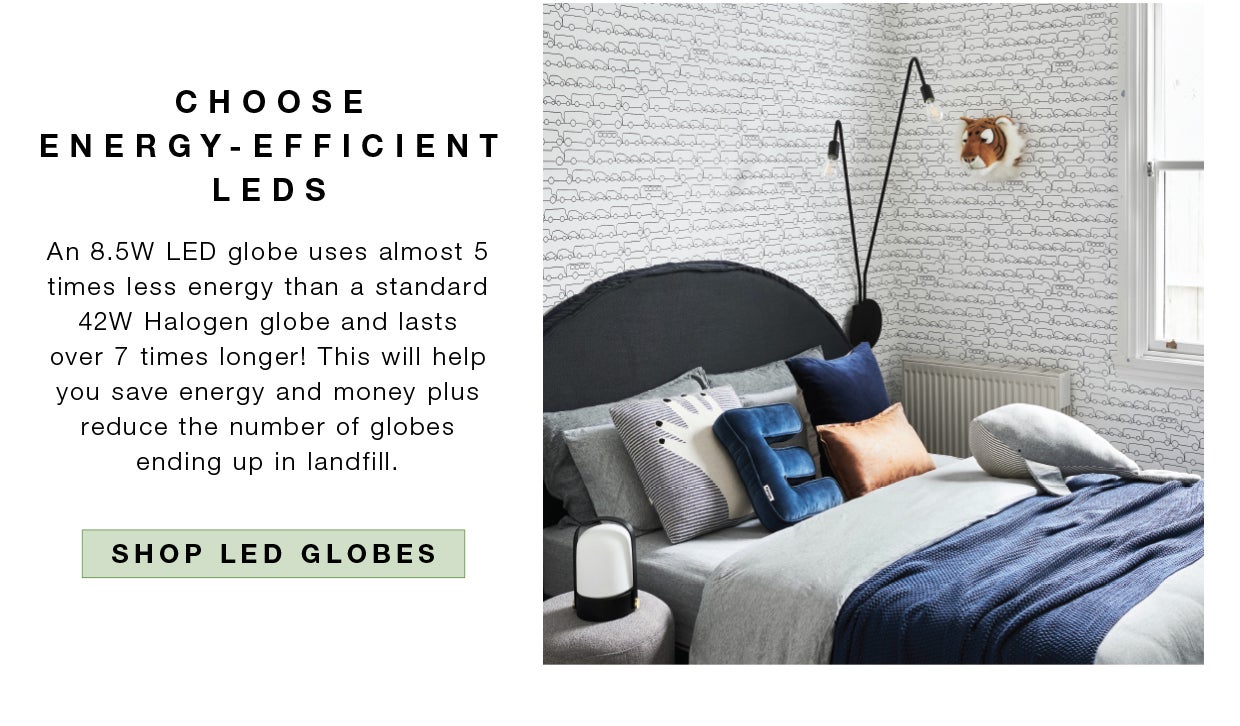
Low energy lighting alternatives such as CFLs (Compact Fluorescent Lamps) and LED (Light Emitting Diodes) cost more to purchase, however the investment is outweighed by the fact that they use only 10-20% of the electricity consumed by a standard incandescent light globe. This produces significant savings on your power bills.
Furthermore, CFLs and LED’s will last from four to 30 years, as opposed to a standard globe that lasts about one year, saving you the inconvenience of having to regularly purchase and replace globes.
And most importantly, energy efficient globes reduce energy consumption and therefore help cut greenhouse gas emissions that are harmful to the environment.
As Australia’s leading national lighting retailer, many of our stores have already made the switch to low energy lighting. We can help you make the switch so you can start saving today! There’s hundreds of energy saving options available, so speak to an expert in store.
Inefficient lighting ban
According to the Australian government, lighting is responsible for 37% of greenhouse gas emissions; household lighting is responsible for 12% of the total greenhouse emissions and commercial lighting such as public and street lighting 25%.
Lighting costs the community over $2 billion in electricity each year and it is predicted that converting to low energy lighting will save Australians 66% off their household lighting bills.
WHICH LIGHT IS WHICH? Incandescent: Due to government regulations, as of November 2009, you are no longer able to purchase standard incandescent globes. These lamps were extremely inefficient because they only converted 5-10% of the energy they produced into light, while the remainder was converted to heat. The result was an extreme waste of electricity.
Halogen: Low voltage halogen downlights are the most commonly used light globes in Australia. As a type of incandescent lamps, although they require lower voltages they are not low energy lamps. In fact, each low voltage halogen lamp generates a kilogram of greenhouse gas every 15 hours, which Is about the same as a standard 60 watt incandescent globe.
Compact Fluorescent Lamps (CFLs): CFLs are fluorescent tubes bent into shape to fit a standard light fitting. They use around 20% of the power required by an incandescent bulb and will last an impressive 6-15 times longer.
On a lifetime basis, a standard 100 watt-equivalent CFL will save 480 kilowatt hours of electricity when compared to an incandescent lamp. During its lifetime, just one CFL bulb has the capacity to reduce greenhouse gas emissions by as much as one tonne.
While the cost of a CFL is greater than an incandescent lamp, CFLs are cheaper when the total life cycle cost is considered. A typical CFL will save you around $50 in its lifetime. Plus you’ll save the expense of six or more incandescent globes and you won’t have to change the bulbs nearly as often.
CFLs are available in a range of colours to suit all applications. The higher the Kelvin (K) rating, the bluer the colour gets. Lower Kelvin-rated CFLs have more yellow and are similar to the light colour of an incandescent globe. The Kelvin rating only refers to the colour of the light emitted, not the brightness. Different colours suit different rooms. Bright daylight (6500K) offers a strong, bright light suited to home offices and work spaces. Cool white (4000K) is suited to task environments like kitchens and laundries. Warm white (2700K) creates a more intimate atmosphere for bedrooms and lounge rooms.
Because CFLs are more efficient, they require a lower wattage globe for the same light output. Check the chart below to see the difference.
Switch to CFLs and save! Check out our CFL facts page for more information.
Light Emitting Diodes (LEDs): LEDs are the next generation of lighting. They don’t generate heat, take no time to reach full brightness, contain no chemicals such as lead or mercury, and emit no UV rays or infrared radiation.
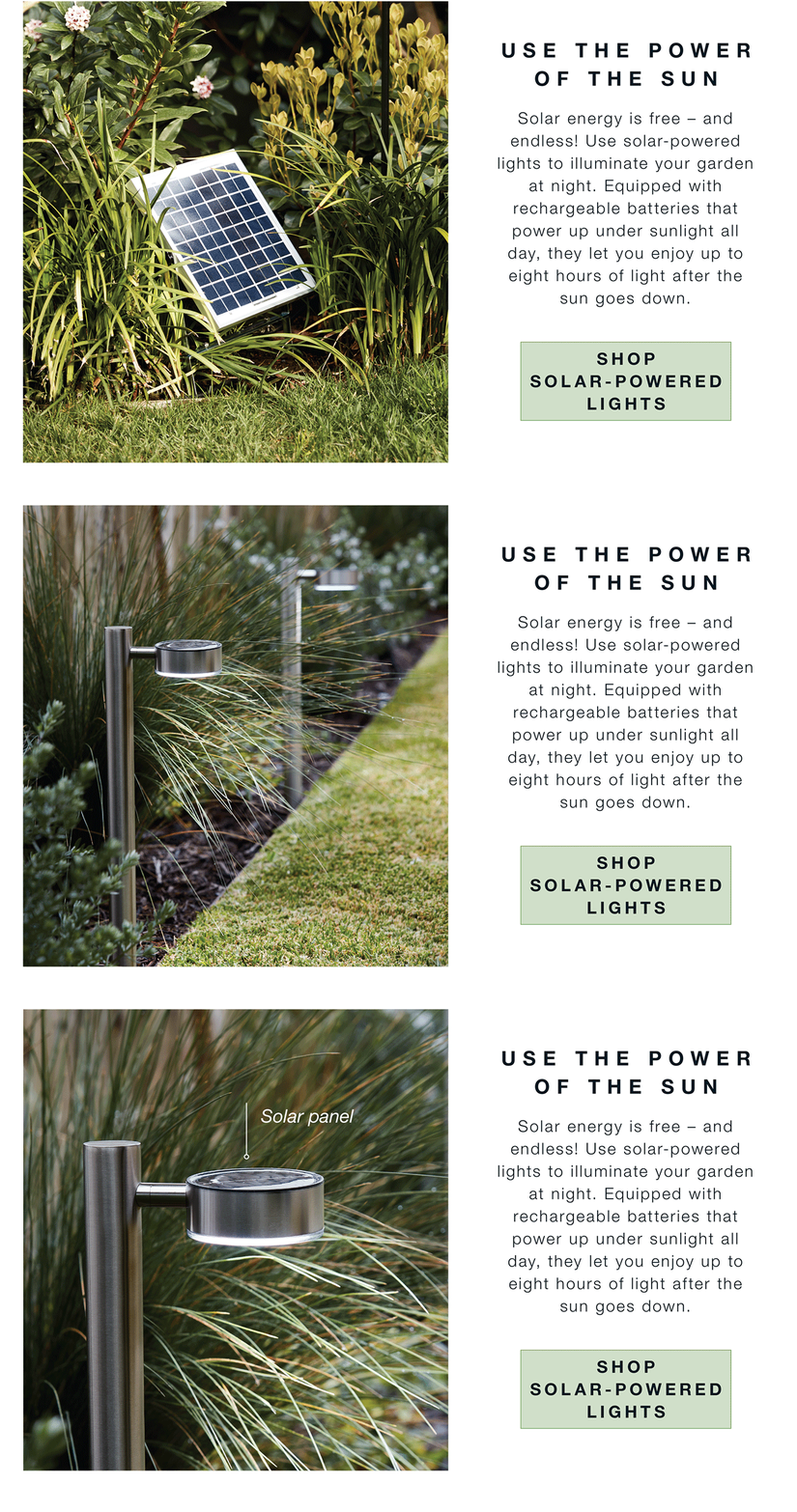
Solar lighting: Commonly used in gardens to light pathways, solar lighting is the ultimate ‘green’ lighting alternative. Solar lighting is entirely self-sufficient and requires only the energy from sunlight to convert into electrical energy. Solar lights only contain very small batteries and solar panels so the light output is only minimal.
For more information about energy saving lighting, visit our energy saving FAQs page. |
|