
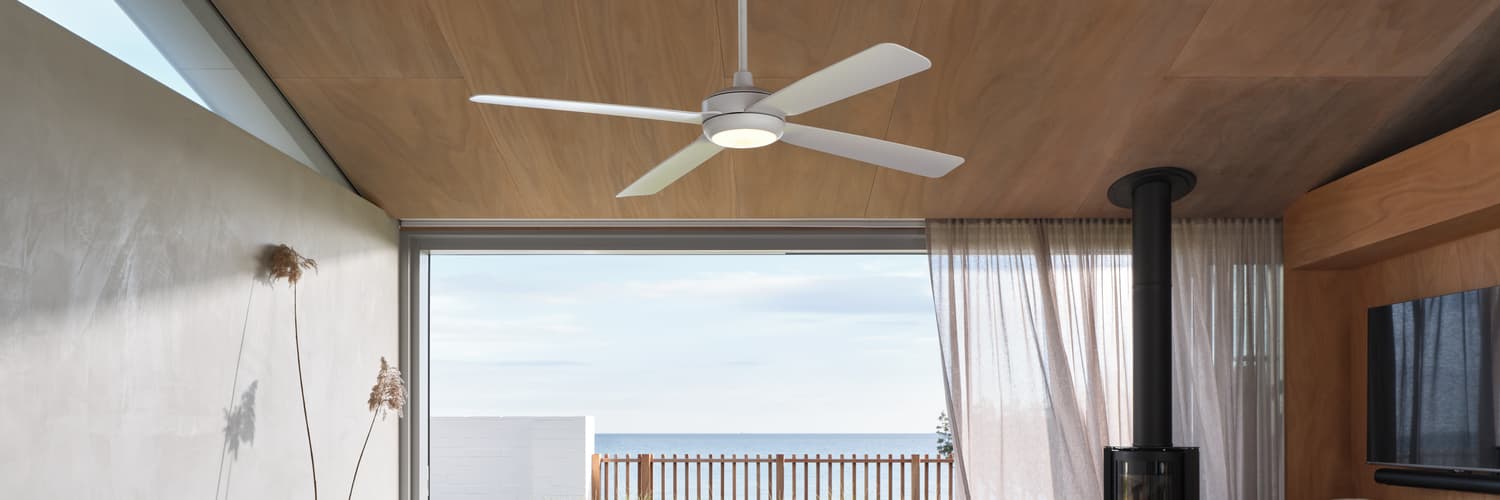
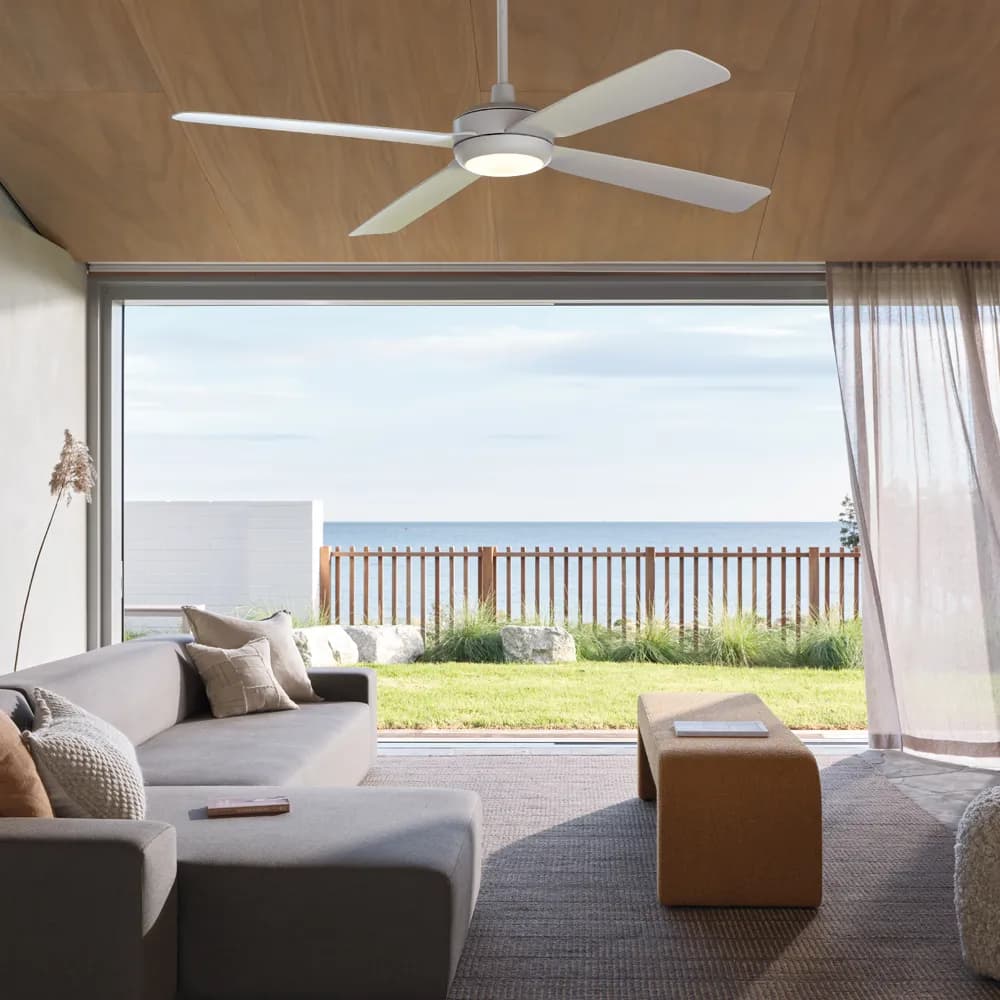
How to Choose a Ceiling Fan
Your Ultimate Guide to Choosing a Ceiling Fan

At Beacon Lighting, we offer Australia’s largest range of ceiling fans – designed locally to match the Australian climate, and backed by over 35 years of industry experience. We know fans aren’t just practical, they’re part of your interior design narrative, helping you strike the right balance between comfort and style.
With so many options, it can be tricky to know which fan will work best for your space. Explore the topics below to find the information you need.

Can I Install a Ceiling Fan In My Space?
Ceiling fans can be installed in most Australian homes, provided they meet local regulations. Fan blades must sit at least 2.1m above the floor, so if your ceiling is 2.4m or higher, you’re in range. For ceilings 2.7m and above, you may need an extension rod to position the fan between 2.1m and 2.5m for optimal airflow. Most fans come with a standard rod, with extension options available as listed on the product page.
If your ceiling is under 2.4m, consider a low-profile or “hugger” fan, which sits closer to the ceiling. These are perfect for smaller rooms but can’t take extension rods due to their fixed mount.
Always refer to the ceiling-to-blade drop measurement listed on the fan product page to ensure compatibility with your space.
Ceiling Height | Fan Profile | Extension Rod Required |
>2.4 meters | Low Profile | No rod required |
2.4 meters | Low Profile / Standard Fan | No rod required |
2.7 meters | Standard Fan | No rod required |
3 meters + | Standard Fan | Extension rod cut to size |
All ceiling fans must be installed by a qualified electrician. For convenience, Beacon Lighting offers third-party installation services, which can be booked after purchase. This installation service is not available in New South Wales. For residents living in NSW, please use our electrician finder to find a preferred Beacon electrician to install your ceiling fan.
How to Choose the Size of Your Ceiling Fan
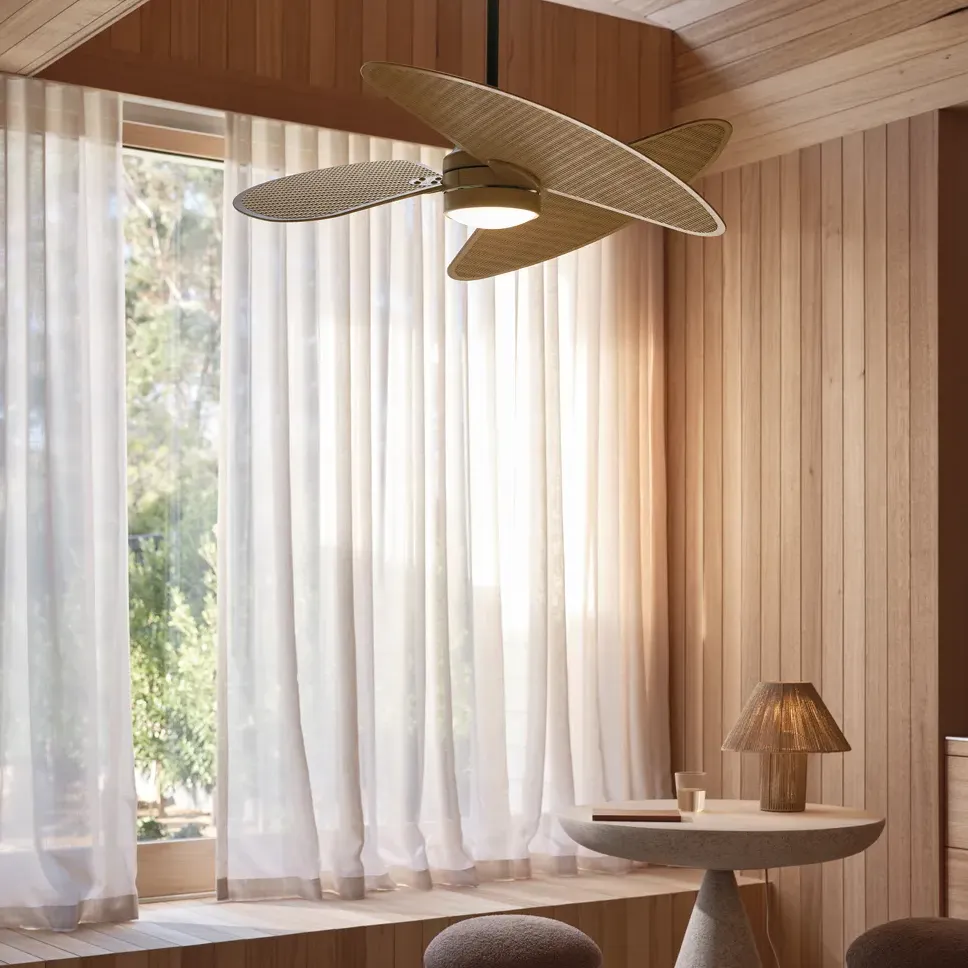
Ceiling fans are measured by their blade span, the distance from the tip of one blade to the tip of the opposite blade, expressed in centimetres. A larger blade span increases the fan’s air coverage, making size an important factor when selecting a fan for your space.
Room Size | Typical Room | Fan Size |
Up to 5m2 | Very small rooms | Up to 107cm (42") |
5m2 to 7m2 | Smaller than average rooms | 107cm – 122cm (42" – 48") |
7m2 to 13m2 | Bedrooms | 122cm – 132cm (48" – 52") |
13m2 to 20m2 | Large rooms – Living rooms, large bedrooms, family rooms | 132cm – 142cm (52" – 56") |
20m2 to 36m2 | Large living spaces | 142cm and larger (56"+) |
Placement matters just as much as size. Since fans work by moving air across your skin to create a cooling effect, they should be installed close to where people spend the most time, like above seating areas in a lounge. Therefore, the ratio of room to fan size isn’t the only consideration when making your selection; it’s position is equally important.
Outdoor and Coastal Rated Ceiling Fans
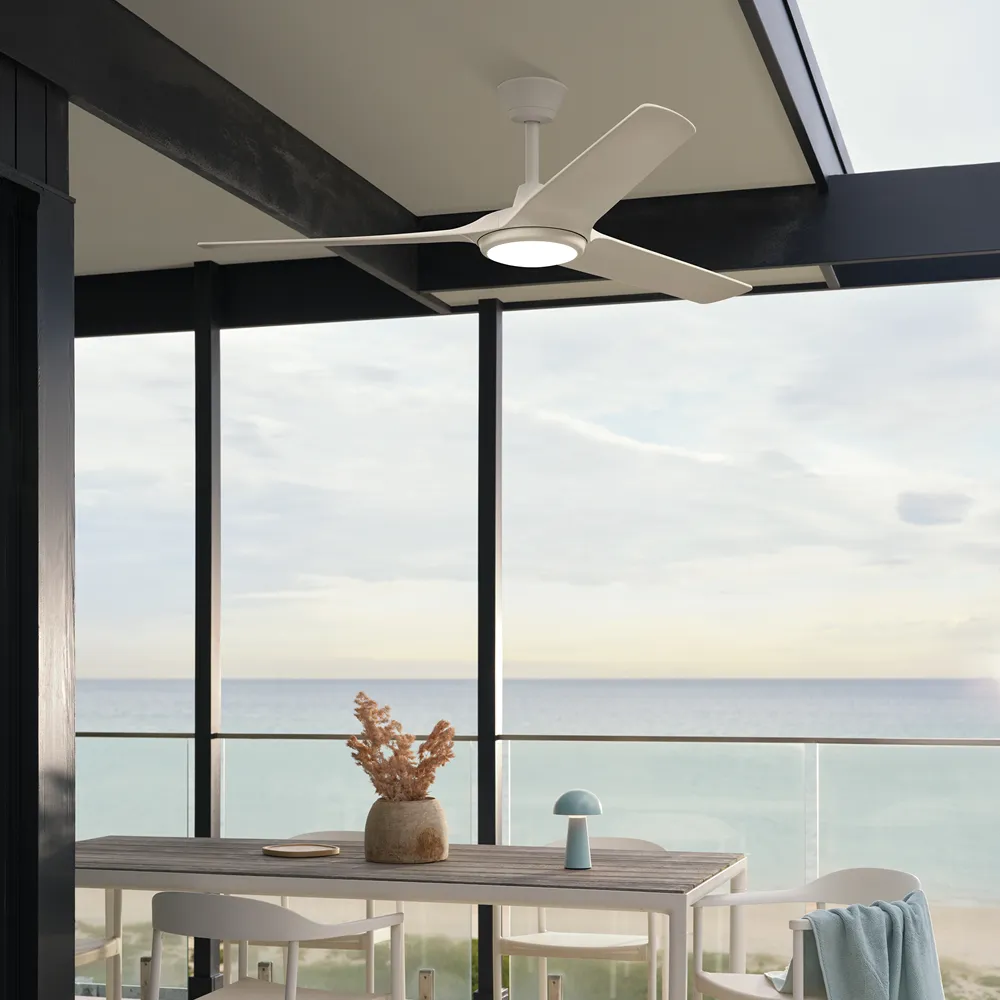
Outdoor living is part of the Australian lifestyle, and a ceiling fan can make your alfresco area more comfortable by providing a gentle breeze. However, not all ceiling fans are made for outdoor use. To ensure durability and warranty coverage, it's essential to choose a fan specifically rated for your outdoor space.
Suitability | Requirements |
Suitable for indoor and alfresco areas provided the fan is fully undercover, protected from water, wind, dust, and salt, with a minimum of 2 walls. | |
Suitable for indoor, alfresco and coastal areas provided the fan is fully undercover, protected from water, wind, dust and salt, with a minimum of 1 walls. |
Most outdoor-rated fans should be installed in fully undercover areas, protected from direct rain, strong winds and heavy dust. Semi-enclosed spaces with at least one wall are ideal, as high winds can affect blade balance. For more exposed spots, choose wet-rated models with sealed construction or a suitable IP rating for water and dust protection.
Coastal homes need fans designed for salt air, as corrosion, rust or tea staining can occur even indoors. Coastal-rated fans are often made from ABS plastic or marine-grade stainless steel to withstand seaside conditions.
Whatever the rating, regular cleaning keeps your fan looking and performing its best. A simple wipe with a damp cloth works for most models, while IP66-rated fans like the Abyss can even be hose-cleaned.
TIP: To find the suitability of a fan, go to the products page, and look at the description or in the specifications for the suitability.

AC vs DC Ceiling Fans
One of the main decisions you'll face when selecting a fan is whether to choose a DC or AC motor. Each option offers unique advantages, so the right choice really depends on what matters most to you.
If energy efficiency, quiet performance, and sleek design are high on your list, DC fans are a smart investment. On the other hand, if you're after reliability, simple wall control, and a lower upfront cost, AC fans are a solid choice.
Both types provide excellent airflow and are far more cost-effective than running an air conditioner, making them great additions to any home.
Key differences: DC vs AC Ceiling Fans
Feature | DC Ceiling Fans | AC Ceiling Fans |
Energy Use | Up to 70% more energy efficient than AC fans, leading to very low running costs. | Still energy efficient, but not as economical as DC models. |
Cost | Typically a higher upfront investment, but pays off with long-term savings on energy bills. | Lower initial cost makes it more budget friendly for short-term or light use. |
Control Options | Remote comes standard with a wall cradle. Includes more speed settings and reverse functionality. Some models offer wall control. | Usually controlled via a wall switch, but remotes are also available. Reverse functionality requires a manual switch on the motor. |
Speed Options | Typically offers 6-9 speed settings. | Usually offers 3 speed settings. |
Design Flexibility | Compact motor size allows for sleeker, more modern fan designs. Great for low ceilings with plenty of low-profile options. | Generally features a larger motor casing, but still available in a range of stylish looks. |

Fan Blades and Airflow
Choosing a fan isn’t just about looks - airflow performance, blade material and blade count all influence how it works in your space.
Airflow Needs
When we speak of airflow, we’re talking about how much air a fan moves at top speed. Bedrooms often need only a gentle low-speed breeze, while large or high-ceiling spaces benefit from high-airflow models (170m³/min or more). Blade shape also affects airflow direction, with some pushing air straight down and others spreading it outward.
Blade Materials
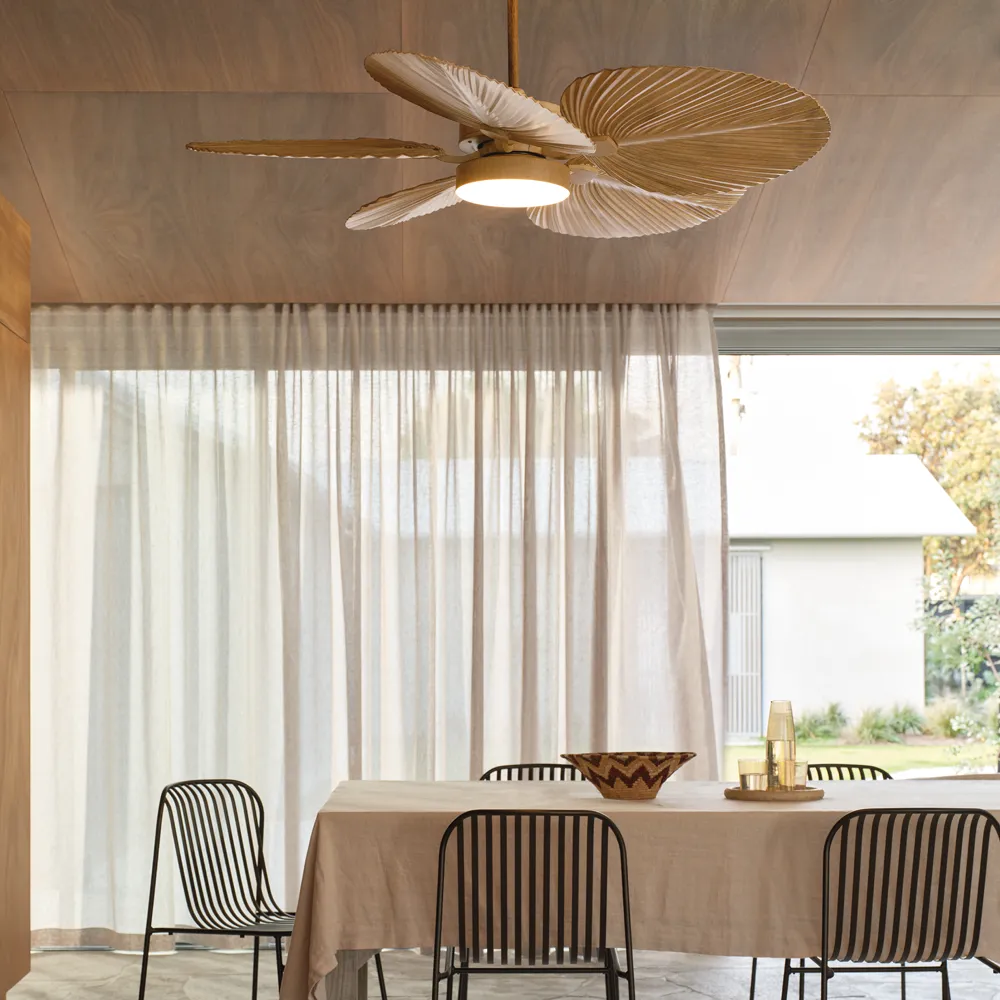
Ceiling fan blades are commonly made from ABS plastic, timber, or metal. ABS plastic is durable, easy to clean, and suits modern homes. Timber brings warmth indoors but needs treatment for outdoor use. Metal is robust, and fantastic for outdoor use, particularly when made of stainless steel. In terms of performance, no single material consistently outperforms the others. If there's any audible difference, metal blades may produce a faint "whooshing" sound at high speeds, but it's usually minimal.
Blade Count
More blades doesn’t always mean better performance. Factors like motor power, blade pitch, fan size and airflow rating matter more. Once those boxes are ticked, choose the blade count that suits your style.
Ceiling Fan Control Options
Choose the perfect way to control your ceiling fan with options designed for convenience, flexibility and smart living.
Remote Control
Most ceiling fan remotes use RF technology, so you don’t need to point directly at the fan - just be within range. While older models couldn’t be paired with wall controls, many new systems can.
DC fans almost always come with a remote and usually can’t support wall control. AC fans typically include wall control with remote options available. All remote-controlled fans must be connected to an isolation switch for safe power cut-off.
Wall Control
Wall-mounted controls are fixed, reliable, and can’t be misplaced. They require licensed installation and extra wiring but make it easy to adjust speed at a glance.
Smart Control
Smart controllers let you operate your fan via app or voice assistant like Alexa or Google Home. Our AC smart system includes a remote handset; our DC smart system is a plug-in module so you can still use the remote.
With the Lucci Connect app, you can automate schedules, link fan use to local weather, and set timers. Smart control also provides better accessibility for people with mobility challenges.
View our help centre article here to learn which of our ceiling fans are smart compatible.
Angled Ceiling Fan Options
The pitch of your raked or vaulted ceiling determines which fans you can use. Some, like hugger fans, suit only flat ceilings; others can handle angles up to 20°. Always check your fan’s specs - some may need an angled ceiling canopy for compatibility.
Why some fans work on a slope
Most fans use a ball joint canopy so they hang level on a sloped surface, but the max angle varies. DC fans with remote receivers often have less canopy space, limiting the pitch they can handle. For steep ceilings, you may also need an extension rod to keep blade clearance safe.

Ceiling Fan Warranties
Lucci Air + Fanaway
Enjoy a 2-year in-home warranty plus a 7-year motor replacement warranty on all hard-wired Lucci or Fanaway fans purchased from 1 October 2022. If purchased or installed by a Beacon Trade member, your in-home warranty extends to 3 years.
Bayside
Bayside fans come with a 2-year in-home warranty and a 4-year parts replacement warranty from the purchase date.
For full details, see our warranty policy or contact warranty@beaconlighting.com.au or 1800 602 243.
Frequently Asked Questions
Please view our easy-to-follow "How-To" video here
ABS stands for Acrylonitrile Butadiene Styrene, a lightweight and durable thermoplastic commonly used for ceiling fan blades. It is rust-proof, impact resistant and ideal for molded blade designs, making it suitable for both indoor and outdoor use.
If you have a remote, and you turn the light on via the remote before leaving the room, then when you leave the room you can turn off the light at the switch. When you return, and you turn the light switch on, the light will come back on but not the fan.
The majority do, except our Moto, Sainz and Calypso fans.
If you have an AC fan with a remote, you will need to change the DIP switches to a different frequency to the other fan. These switches are located inside the battery compartment of the remote as well as on the receiver unit located inside the ceiling canopy of the fan. If you have a DC fan, the remote might be paired to both fans. To correct this, turn off both fans via the isolation switch and then follow this 'how-to' video here. Ensure you are only doing this for one fan at a time to pair it to the remote you require.
DC stands for Direct Current, referring to the type of motor used in the fan. DC ceiling fans are typically more energy efficient, quieter and offer more speed settings compared to traditional AC (Alternating Current) fans.
Unfortunately, you cannot use a fan wall controller and a remote at the same time.
If the fan says it has a GX53 globe or takes an ES globe, this is replaceable. There are also some fan lights that are replaceable through spare parts.
We offer an angled ceiling canopy that can be installed onto ceilings up to 45 degrees. Make sure your fan is compatible with the canopy before buying. Alternatively, you can cut a wooden wedge the same size as the canopy of the fan. Then cut one side to the angle pitch of the roof with the other side straight and paint it the same colour as your ceiling. You may also need an extension rod to clear the pitch of the ceiling.
Depending on the size of the room, we would recommend either a 122cm or a 132cm fan, which is DC and has either plastic or wooden blades, as this will make the fan as quiet as possible.
Yes, it is a requirement under Australian and New Zealand regulations that a switch is in close proximity to a motor, the fan being a motor. This can take the look of a light switch on the wall.
With our extensive range of ceiling fans you can easily create the perfect space. Once you’ve found your preferred fan for your home, we also offer an installation service to ensure your ceiling fan is installed safely and securely. Head into your local Beacon Lighting store to start shopping today, or visit our website to browse through our range of ceiling fans.
To find out more about our installation services, click here. Please note, this service is not available in New South Wales. For residents living in NSW please use our electrician finder to find a preferred Beacon electrician to install your ceiling fan.